Trigonometric Functions Exercise 3.1
Assessment Worksheets
Study notes and Summary
A mathematician knows how to solve a problem, he can not solve it. – MILNE
3.1 Introduction
The word ’trigonometry’ is derived from the Greek words ’trigon’ and ‘metron’ and it means ‘measuring the sides of a triangle’. The subject was originally developed to solve geometric problems involving triangles. It was studied by sea captains for navigation, surveyor to map out the new lands, by engineers and others. Currently, trigonometry is used in many areas such as the science of seismology, designing electric circuits, describing the state of an atom, predicting the heights of tides in the ocean, analysing a musical tone and in many other areas.

Arya Bhatt (476-550 B.C.)
In earlier classes, we have studied the trigonometric ratios of acute angles as the ratio of the sides of a right angled triangle. We have also studied the trigonometric identities and application of trigonometric ratios in solving the problems related to heights and distances. In this Chapter, we will generalise the concept of trigonometric ratios to trigonometric functions and study their properties.
3.2 Angles

Fig 3.1
Angle is a measure of rotation of a given ray about its initial point. The original ray is
called the initial side and the final position of the ray after rotation is called the terminal side of the angle. The point of rotation is called the vertex. If the direction of rotation is anticlockwise, the angle is said to be positive and if the direction of rotation is clockwise, then the angle is negative (Fig 3.1).
The measure of an angle is the amount of rotation performed to get the terminal side from the initial side. There are several units for measuring angles. The definition of an angle
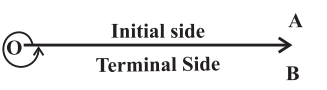
Fig 3.2
Fig 3.2 suggests a unit, viz. one complete revolution from the position of the initial side as indicated in Fig 3.2.
This is often convenient for large angles. For example, we can say that a rapidly spinning wheel is making an angle of say 15 revolution per second. We shall describe two other units of measurement of an angle which are most commonly used, viz. degree measure and radian measure.
3.2.1 Degree measure
If a rotation from the initial side to terminal side is $\left(\dfrac{1}{360}\right)^{\text{th }}$ of a revolution, the angle is said to have a measure of one degree, written as $1^{\circ}$. A degree is divided into 60 minutes, and a minute is divided into 60 seconds. One sixtieth of a degree is called a minute, written as $1^{\prime}$, and one sixtieth of a minute is called a second, written as $1^{\prime \prime}$. Thus, $\quad 1^{\circ}=60^{\prime}, \quad 1^{\prime}=60^{\prime \prime}$
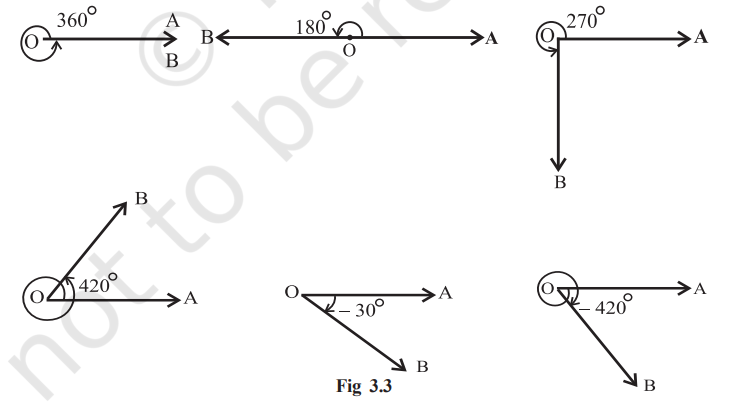
Some of the angles whose measures are $360^{\circ}, 180^{\circ}, 270^{\circ}, 420^{\circ},-30^{\circ},-420^{\circ}$ are shown in Fig 3.3.
3.2.2 Radian measure
There is another unit for measurement of an angle, called the radian measure. Angle subtended at the centre by an arc of length 1 unit in a unit circle (circle of radius 1 unit) is said to have a measure of 1 radian. In the Fig 3.4(i) to (iv), $OA$ is the initial side and $OB$ is the terminal side. The figures show the angles whose measures are 1 radian, -1 radian, $1 \dfrac{1}{2}$ radian and $-1 \dfrac{1}{2}$ radian.
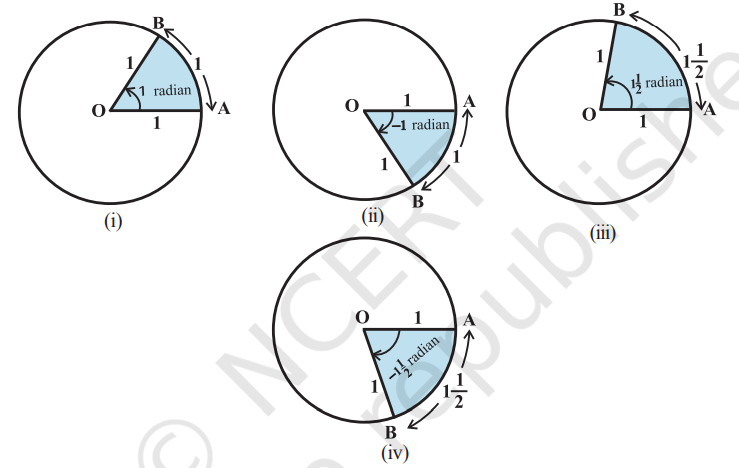
Fig 3.4 (i) – (iv)
We know that the circumference of a circle of radius 1 unit is $2 \pi$. Thus, one complete revolution of the initial side subtends an angle of $2 \pi$ radian.
More generally, in a circle of radius $r$, an arc of length $r$ will subtend an angle of 1 radian. It is well-known that equal arcs of a circle subtend equal angle at the centre. Since in a circle of radius $r$, an arc of length $r$ subtends an angle whose measure is 1 radian, an arc of length $l$ will subtend an angle whose measure is $\dfrac{l}{r}$ radian. Thus, if in a circle of radius $r$, an arc of length $l$ subtends an angle $\theta$ radian at the centre, we have $\theta=\dfrac{l}{r}~$ or $~l=r ~\theta$.
3.2.3 Relation between radian and real numbers
Consider the unit circle with centre $O$. Let $A$ be any point on the circle. Consider OA as initial side of an angle. Then the length of an arc of the circle will give the radian measure of the angle which the arc will subtend at the centre of the circle. Consider the line PAQ which is tangent to the circle at A. Let the point A represent the real number zero, AP represents positive real number and AQ represents negative real numbers (Fig 3.5). If we rope the line $AP$ in the anticlockwise direction along the circle, and $AQ$ in the clockwise direction, then every real number will correspond to a radian measure and conversely. Thus, radian measures and real numbers can be considered as one and the same.

3.2.4 Relation between degree and radian Since a circle subtends at the centre
Since a circle subtends at the centre an angle whose radian measure is $2 \pi$ and its degree measure is $360^{\circ}$, it follows that
$
2 \pi \text{ radian }=360^{\circ} \quad \text{ or } \quad \pi \text{ radian }=180^{\circ}
$
The above relation enables us to express a radian measure in terms of degree measure and a degree measure in terms of radian measure. Using approximate value of $\pi$ as $\dfrac{22}{7}$, we have
$
1 \text{ radian }=\dfrac{180^{\circ}}{\pi}=57^{\circ} 16^{\prime} \text{ approximately. }
$
Also $\quad 1^{\circ}=\dfrac{\pi}{180}$ radian $=0.01746$ radian approximately.
The relation between degree measures and radian measure of some common angles are given in the following table:
$
\begin{array}{|c|c|c|c|c|c|c|c|}
\hline
\text{Degree} & 30^\circ & 45^\circ & 60^\circ & 90^\circ & 180^\circ & 270^\circ & 360^\circ \\
\hline
\text{Radian} & \dfrac{\pi}{6} & \dfrac{\pi}{4} & \dfrac{\pi}{3} & \dfrac{\pi}{2} & \pi & \dfrac{3\pi}{2} & 2\pi \\
\hline
\end{array}
$
Notational Convention
Since angles are measured either in degrees or in radians, we adopt the convention that whenever we write angle $\theta^{\circ}$, we mean the angle whose degree measure is $\theta$ and whenever we write angle $\beta$, we mean the angle whose radian measure is $\beta$.
Note that when an angle is expressed in radians, the word ‘radian’ is frequently omitted. Thus, $\pi=180^{\circ}$ and $\dfrac{\pi}{4}=45^{\circ}$ are written with the understanding that $\pi$ and $\dfrac{\pi}{4}$ are radian measures. Thus, we can say that
$
\begin{aligned}
& \text{ Radian measure }=\dfrac{\pi}{180} \times \text{ Degree measure } \\
& \text{ Degree measure }=\dfrac{180}{\pi} \times \text{ Radian measure }
\end{aligned}
$
Example 1 Convert $40^{\circ} 20^{\prime}$ into radian measure.
Solution We know that $180^{\circ}=\pi$ radian.
Hence $\quad 40^{\circ} 20^{\prime}=40 \dfrac{1}{3}$ degree $=\dfrac{\pi}{180} \times \dfrac{121}{3}$ radian $=\dfrac{121 \pi}{540}$ radian.
Therefore
$
\quad 40^{\circ} 20^{\prime}=\dfrac{121 \pi}{540} \text{ radian.}
$
Example 2 Convert 6 radians into degree measure.
Solution We know that $\pi$ radian $=180^{\circ}$.
Hence
$
\begin{aligned}
6 \text{ radians } & =\dfrac{180}{\pi} \times 6 \text{ degree }=\dfrac{1080 \times 7}{22} \text{ degree } \\
& =343 \dfrac{7}{11} \text{ degree }=343^{\circ}+\dfrac{7 \times 60}{11} \text{ minute } \quad[\text{ as } 1^{\circ}=60^{\prime}] \\
& =343^{\circ}+38^{\prime}+\dfrac{2}{11} \text{ minute } \quad[\text{ as } 1^{\prime}=60^{\prime \prime}] \\
& =343^{\circ}+38^{\prime}+10.9^{\prime \prime} \quad=343^{\circ} 38^{\prime} 11^{\prime \prime} \text{ approximately. }
\end{aligned}
$
Hence $\quad 6$ radians $=343^{\circ} 38^{\prime} 11^{\prime \prime}$ approximately.
Example 3 Find the radius of the circle in which a central angle of $60^{\circ}$ intercepts an arc of length $37.4 cm$ (use $\pi=\dfrac{22}{7}$).
Solution Here $l=37.4 cm$ and $\theta=60^{\circ}=\dfrac{60 \pi}{180}$ radian $=\dfrac{\pi}{3}$
Hence, $\quad$ by $r=\dfrac{l}{\theta}$, we have
$
r=\dfrac{37.4 \times 3}{\pi}=\dfrac{37.4 \times 3 \times 7}{22}=35.7 cm
$
Example 4 The minute hand of a watch is $1.5 cm$ long. How far does its tip move in 40 minutes? (Use $\pi=3.14$ ).
Solution In 60 minutes, the minute hand of a watch completes one revolution. Therefore, in 40 minutes, the minute hand turns through $\dfrac{2}{3}$ of a revolution. Therefore, $\theta=\dfrac{2}{3} \times 360^{\circ}$ or $\dfrac{4 \pi}{3}$ radian. Hence, the required distance travelled is given by
$
l=r \theta=1.5 \times \dfrac{4 \pi}{3} cm=2 \pi cm=2 \times 3.14 cm=6.28 cm .
$
Example 5 If the arcs of the same lengths in two circles subtend angles $65^{\circ}$ and $110^{\circ}$ at the centre, find the ratio of their radii.
Solution Let $r_1$ and $r_2$ be the radii of the two circles. Given that
$
\theta_1=65^{\circ}=\dfrac{\pi}{180} \times 65=\dfrac{13 \pi}{36} \text{ radian }
$
and
$
\quad \theta_2=110^{\circ}=\dfrac{\pi}{180} \times 110=\dfrac{22 \pi}{36} \text{ radian }
$
Let $l$ be the length of each of the arc. Then $l=r_1 \theta_1=r_2 \theta_2$, which gives
$
\dfrac{13 \pi}{36} \times r_1=\dfrac{22 \pi}{36} \times r_2 \text{, i.e., } \dfrac{r_1}{r_2}=\dfrac{22}{13}
$
Hence $\quad r_1: r_2=22: 13$.
Exercise 3.1
EXERCISE 3.1
1. Find the radian measures corresponding to the following degree measures:
(i) $25^{\circ}$
(ii) $-47^{\circ} 30^{\prime}$
(iii) $240^{\circ}$
(iv) $520^{\circ}$
Show Answer
Answer :
(i) $25^{\circ}$
We know that $180^{\circ}=\pi$ radian
$\therefore \ \ 25^{\circ}=\dfrac{\pi}{180} \times 25$ radian $=\dfrac{5 \pi}{36}$ radian
(ii) $-47^{\circ} 30^{\prime}$
$- 47^{\circ} 30^{\prime}={ }{-47 \dfrac{1}{2}}$ $\qquad[1^{\circ}=60^{\prime}]$
$\hspace{1.3cm}=\dfrac{-95}{2}$ degree
Since $180^{\circ}=\pi$ radian
$\dfrac{-95}{2}$ degree $=\dfrac{\pi}{180} \times\left(\dfrac{-95}{2}\right)$ radian
$\hspace{1.8cm}=\left(\dfrac{-19}{36 \times 2}\right) \pi$ radian
$\hspace{1.8cm}=\dfrac{-19}{72} \pi$ radian
$\therefore \ \ -47^{\circ} 30^{\prime}=\dfrac{-19}{72} \pi$ radian
(iii) $240^{\circ}$
We know that $180^{\circ}=\pi$ radian
$\therefore \ \ 240^{\circ}=\dfrac{\pi}{180} \times 240$ radian $=\dfrac{4}{3} \pi$ radian
(iv) $520^{\circ}$
We know that $180^{\circ}=\pi$ radian
$\therefore \ \ 520^{\circ}=\dfrac{\pi}{180} \times 520$ radian $=\dfrac{26 \pi}{9}$ radian
2. Find the degree measures corresponding to the following radian measures $\bigg($ Use $\pi=\dfrac{22}{7} \bigg)$
(i) $\dfrac{11}{16}$
(ii) $-4$
(iii) $\dfrac{5 \pi}{3}$
(iv) $\dfrac{7 \pi}{6}$
Show Answer
Answer :
(i) $\dfrac{11}{16}$
We know that $\pi$ radian $=180^{\circ}$
$\therefore \ \ \dfrac{11}{16}$ radian $=\dfrac{180}{\pi} \times \dfrac{11}{16}$ degree
$\hspace{2cm}=\dfrac{45 \times 11}{\pi \times 4}$ degree
$\hspace{2cm}=\dfrac{45 \times 11 \times 7}{22 \times 4}$ degree $=\dfrac{315}{8}$ degree
$\hspace{2cm}=39 \dfrac{3}{8}$ degree
$\hspace{2cm}=39^{\circ}+\dfrac{3 \times 60}{8}$ minutes $\quad[1^{\circ}=60^{\prime}]$
$\hspace{2cm}=39^{\circ}+22^{\prime}+\dfrac{1}{2}$ minutes
$\hspace{2cm}=39^{\circ} 22^{\prime} 30^{\prime \prime} \quad[1^{\prime}=60^{\prime \prime}]$
(ii) $-4$
We know that $\pi$ radian $=180^{\circ}$
$
\begin{aligned}
-4 \text{ radian } & =\dfrac{180}{\pi} \times(-4) \text{ degree }=\dfrac{180 \times 7(-4)}{22} \text{ degree } \\
& =\dfrac{-2520}{11} \text{ degree }=-229 \dfrac{1}{11} \text{ degree } \\
& =-229^{\circ}+\dfrac{1 \times 60}{11} \text{ minutes } \quad[1^{\circ}=60^{\prime}] \\
& =-229^{\circ}+5^{\prime}+\dfrac{5}{11} \text{ minutes } \\
& =-229^{\circ} 5^{\prime} 27^{\prime \prime} \quad[1^{\prime}=60^{\prime \prime}]
\end{aligned}
$
(iii) $\dfrac{5 \pi}{3}$
We know that $\pi$ radian $=180^{\circ}$
$\therefore \ \ \dfrac{5 \pi}{3}$ radian $=\dfrac{180}{\pi} \times \dfrac{5 \pi}{3}$ degree $=300^{\circ}$
(iv) $\dfrac{7 \pi}{6}$
We know that $\pi$ radian $=180^{\circ}$
$\therefore \ \ \dfrac{7 \pi}{6}$ radian $=\dfrac{180}{\pi} \times \dfrac{7 \pi}{6}=210^{\circ}$
3. A wheel makes $360$ revolutions in one minute. Through how many radians does it turn in one second?
Show Answer
Answer :
Number of revolutions made by the wheel in $1$ minute $=360$
$\therefore \ \ $ Number of revolutions made by the wheel in $1$ second $=\dfrac{360}{60}=6$
In one complete revolution, the wheel turns an angle of $2 \pi$ radian.
Hence, in $6$ complete revolutions, it will turn an angle of $6 \times 2 \pi$ radian, i.e., $12 \pi$ radian
Thus, in one second, the wheel turns an angle of $12 \pi$ radian.
4. Find the degree measure of the angle subtended at the centre of a circle of radius $100 cm$ by an arc of length $22 cm$ $\bigg($ Use $\pi=\dfrac{22}{7}\bigg)$
Show Answer
Answer :
We know that in a circle of radius $r$ unit, if an arc of length / unit subtends an angle $\theta$ radian at the centre, then
$\theta=\dfrac{1}{r}$
Therefore, $r =100 cm, \ I=22 cm, \ $ we have
$\hspace{1.3cm}\theta=\dfrac{22}{100}$ radian $=\dfrac{180}{\pi} \times \dfrac{22}{100}$ degree $=\dfrac{180 \times 7 \times 22}{22 \times 100}$ degree
$\hspace{1.5cm}=\dfrac{126}{10}$ degree $=12 \dfrac{3}{5}$ degree $=12^{\circ} 36^{\prime} \quad[1^{\circ}=60^{\prime}]$
Thus, the required angle is $12^{\circ} 36^{’}$
5. In a circle of diameter $40 cm$, the length of a chord is $20 cm$. Find the length of minor arc of the chord.
Show Answer
Answer :
Diameter of the circle $=40 cm$
$\therefore \ \ $ Radius $(r)$ of the circle $=\dfrac{40}{2} cm=20 cm$
Let $A B$ be a chord (length $=20 cm$ ) of the circle.

In $\triangle OAB, $
$OA=OB=$ Radius of circle $=20 cm$
Also, $ \ A B=20 cm$
Thus, $\triangle OAB$ is an equilateral triangle.
$\therefore \ \ \ \theta=60^{\circ}=\dfrac{\pi}{3}$ radian
We know that in a circle of radius $r$ unit, if an arc of length / unit subtends an angle $\theta$ radian at the centre, then
$\theta=\dfrac{l}{r}$
$\dfrac{\pi}{3}=\dfrac{\overline{AB}}{20} \rightarrow \overline{AB}=\dfrac{20 \pi}{3} cm$
6. If in two circles, arcs of the same length subtend angles $60^{\circ}$ and $75^{\circ}$ at the centre, find the ratio of their radii.
Show Answer
Answer :
Let the radii of the two circles be ${r_1}$ and ${r_2} \ $. Let an arc of length / subtend an angle of $60^{\circ}$ at the centre of the circle of radius $r_1$, while let an arc of length / subtend an angle of $75^{\circ}$ at the centre of the circle of radius $r_2$.
Now, $60^{\circ}=\dfrac{\pi}{3}$ radian and $75^{\circ}=\dfrac{5 \pi}{12}$ radian
We know that in a circle of radius $r$ unit, if an arc of length / unit subtends an angle $\theta$ radian at the centre, then
$\theta=\dfrac{l}{r}$ or $l=r \theta$
$\therefore \ \ l=\dfrac{r_1 \pi}{3}$ and $l=\dfrac{r_2 5 \pi}{12}$
$\Rightarrow \dfrac{r_1 \pi}{3}=\dfrac{r_2 5 \pi}{12}$
$\Rightarrow r_1=\dfrac{r_2 5}{4}$
$\Rightarrow \dfrac{r_1}{r_2}=\dfrac{5}{4}$
Thus, the ratio of the radii is $5:4.$
7. Find the angle in radian through which a pendulum swings if its length is $75 cm$ and the tip describes an arc of length
(i) $10 cm$
(ii) $15 cm$
(iii) $21 cm$
Show Answer
Answer :
We know that in a circle of radius $r$ unit, if an arc of length / unit subtends an angle $\theta$ radian at the centre, then $\theta=\dfrac{l}{r}$
It is given that $r=75 cm$
(i) Here, $I=10 cm$
$\hspace{1.1cm}\theta=\dfrac{10}{75}$ radian $=\dfrac{2}{15}$ radian
(ii) Here, $I=15 cm$
$\hspace{1.2cm}\theta=\dfrac{15}{75}$ radian $=\dfrac{1}{5}$ radian
(iii) Here, $I=21 cm$
$\hspace{1.2cm}\theta=\dfrac{21}{75}$ radian $=\dfrac{7}{25}$ radian