Organic Chemistry Some Basic Principles And Techniques Part-2
Assessment Worksheets
Study Notes and Summary
12.5 NOMENCLATURE OF ORGANIC COMPOUNDS
Organic chemistry deals with millions of compounds. In order to clearly identify them, a systematic method of naming has been developed and is known as the IUPAC (International Union of Pure and Applied Chemistry) system of nomenclature. In this systematic nomenclature, the names are correlated with the structure such that the reader or listener can deduce the structure from the name.
Before the IUPAC system of nomenclature, however, organic compounds were assigned names based on their origin or certain properties. For instance, citric acid is named so because it is found in citrus fruits and the acid found in red ant is named formic acid since the Latin word for ant is formica. These names are traditional and are considered as trivial or common names. Some common names are followed even today. For example, Buckminsterfullerene is a common name given to the newly discovered $\mathrm{C_60}$ cluster (a form of carbon) noting its structural similarity to the geodesic domes popularised by the famous architect R. Buckminster Fuller. Common names are useful and in many cases indispensable, particularly when the alternative systematic names are lengthy and complicated. Common names of some organic compounds are given in Table 12.1.
Table 12.1 Common or Trivial Names of Some Organic Compounds
| Compound | Common name |
|---|---|
| $\mathrm{CH_4}$ | Methane |
| $\mathrm{H_3} \mathrm{CCH_2} \mathrm{CH_2} \mathrm{CH_3}$ | $n$-Butane |
| $\left(\mathrm{H_3} \mathrm{C_2} \mathrm{CHCH_3}\right.$ | Isobutane |
| $\left(\mathrm{H_3} \mathrm{C}\right)_{4} \mathrm{C}$ | Neopentane |
| $\mathrm{H_3} \mathrm{CCH_2} \mathrm{CH_2} \mathrm{OH}$ | $n$-Propyl alcohol |
| $\mathrm{HCHO}$ | Formaldehyde |
| $\left(\mathrm{H_3} \mathrm{C}\right)_{2} \mathrm{CO}$ | Acetone |
| $\mathrm{CHCl_3}$ | Chloroform |
| $\mathrm{CH_3} \mathrm{COOH}$ | Acetic acid |
| $\mathrm{C_6} \mathrm{H_6}$ | Benzene |
| $\mathrm{C_6} \mathrm{H_5} \mathrm{OCH_3}$ | Anisole |
| $\mathrm{C_6} \mathrm{H_5} \mathrm{NH_2}$ | Aniline |
| $\mathrm{C_6} \mathrm{H_5} \mathrm{COCH_3}$ | Acetophenone |
| $\mathrm{CH_3} \mathrm{OCH_2} \mathrm{CH_3}$ | Ethyl methyl ether |
12.5.1 The IUPAC System of Nomenclature
A systematic name of an organic compound is generally derived by identifying the parent hydrocarbon and the functional group(s) attached to it. See the example given below.
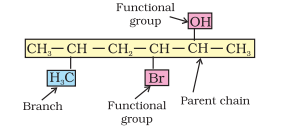
By further using prefixes and suffixes, the parent name can be modified to obtain the actual name. Compounds containing carbon and hydrogen only are called hydrocarbons. A hydrocarbon is termed saturated if it contains only carbon-carbon single bonds. The IUPAC name for a homologous series of such compounds is alkane. Paraffin (Latin: little affinity) was the earlier name given to these compounds. Unsaturated hydrocarbons are those, which contain at least one carboncarbon double or triple bond.
12.5.2 IUPAC Nomenclature of Alkanes
Straight chain hydrocarbons: The names of such compounds are based on their chain structure, and end with suffix ‘-ane’ and carry a prefix indicating the number of carbon atoms present in the chain (except from $\mathrm{CH_4}$ to $\mathrm{C_4} \mathrm{H_{10}}$, where the prefixes are derived from trivial names). The IUPAC names of some straight chain saturated hydrocarbons are given in Table 12.2. The alkanes in Table 12.2 differ from each other by merely the number of $-\mathrm{CH_2}$ groups in the chain. They are homologues of alkane series.
Table 12.2 IUPAC Names of Some Unbranched Saturated Hydrocarbons
| Name | Molecular formula | Name | Molecular formula |
|---|---|---|---|
| Methane | $\mathrm{CH_4}$ | Heptane | $\mathrm{C_7} \mathrm{H_{16}}$ |
| Ethane | $\mathrm{C_2} \mathrm{H_6}$ | Octane | $\mathrm{C_8} \mathrm{H_{18}}$ |
| Propane | $\mathrm{C_3} \mathrm{H_8}$ | Nonane | $\mathrm{C_9} \mathrm{H_{20}}$ |
| Butane | $\mathrm{C_4} \mathrm{H_{10}}$ | Decane | $\mathrm{C_{10}} \mathrm{H_{22}}$ |
| Pentane | $\mathrm{C_5} \mathrm{H_{12}}$ | Icosane | $\mathrm{C_{20}} \mathrm{H_{42}}$ |
| Hexane | $\mathrm{C_6} \mathrm{H_{14}}$ | Triacontane | $\mathrm{C_{30}} \mathrm{H_{62}}$ |
Branched chain hydrocarbons: In a branched chain compound small chains of carbon atoms are attached at one or more carbon atoms of the parent chain. The small carbon chains (branches) are called alkyl groups. For example:

In order to name such compounds, the names of alkyl groups are prefixed to the name of parent alkane. An alkyl group is derived from a saturated hydrocarbon by removing a hydrogen atom from carbon. Thus, $\mathrm{CH_4}$ becomes $-\mathrm{CH_3}$ and is called methyl group. An alkyl group is named by substituting ’ $y$ l’ for ‘ane’ in the corresponding alkane. Some alkyl groups are listed in Table 12.3.
Table 12.3 Some Alkyl Groups
| Alkane | Alkyl group | ||
|---|---|---|---|
| Molecular formula | Name of alkane | Structural formula | Name of alkyl group |
| $\mathrm{CH_4}$ | Methane | $-\mathrm{CH_3}$ | Methyl |
| $\mathrm{C_2} \mathrm{H_6}$ | Ethane | $-\mathrm{CH_2} \mathrm{CH_3}$ | Ethyl |
| $\mathrm{C_3} \mathrm{H_8}$ | Propane | $-\mathrm{CH_2} \mathrm{CH_2} \mathrm{CH_3}$ | Propyl |
| $\mathrm{C_4} \mathrm{H_{10}}$ | Butane | $-\mathrm{CH_2} \mathrm{CH_2} \mathrm{CH_2} \mathrm{CH_3}$ | Butyl |
| $\mathrm{C_{10}} \mathrm{H_{22}}$ | Decane | $-\mathrm{CH_2}\left(\mathrm{CH_2}\right)_{8} \mathrm{CH_3}$ | Decyl |
Abbreviations are used for some alkyl groups. For example, methyl is abbreviated as Me, ethyl as Et, propyl as Pr and butyl as Bu. The alkyl groups can be branched also. Thus, propyl and butyl groups can have branched structures as shown below.
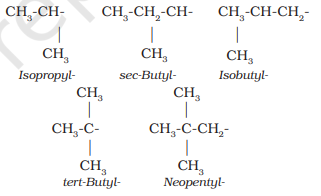
Common branched groups have specific trivial names. For example, the propyl groups can either be n-propyl group or isopropyl group. The branched butyl groups are called sec-butyl, isobutyl and tert-butyl group. We also encounter the structural unit, $-\mathrm{CH_2} \mathrm{C}\left(\mathrm{CH_3}\right)_{3}$, which is called neopentyl group.
Nomenclature of branched chain alkanes: We encounter a number of branched chain alkanes. The rules for naming them are given below.
1. First of all, the longest carbon chain in the molecule is identified. In the example (I) given below, the longest chain has nine carbons and it is considered as the parent or root chain. Selection of parent chain as shown in (II) is not correct because it has only eight carbons.
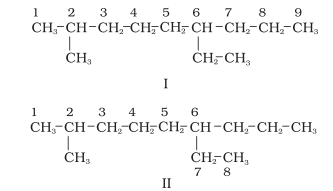
2. The carbon atoms of the parent chain are numbered to identify the parent alkane and to locate the positions of the carbon atoms at which branching takes place due to the substitution of alkyl group in place of hydrogen atoms. The numbering is done in such a way that the branched carbon atoms get the lowest possible numbers. Thus, the numbering in the above example should be from left to right (branching at carbon atoms 2 and 6) and not from right to left (giving numbers 4 and 8 to the carbon atoms at which branches are attached).
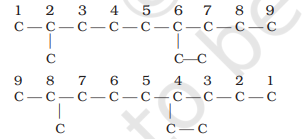
3. The names of alkyl groups attached as a branch are then prefixed to the name of the parent alkane and position of the substituents is indicated by the appropriate numbers. If different alkyl groups are present, they are listed in alphabetical order. Thus, name for the compound shown above is: 6-ethyl-2methylnonane. [Note: the numbers are separated from the groups by hyphens and there is no break between methyl and nonane.]
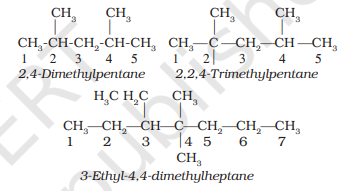
4. If two or more identical substituent groups are present then the numbers are separated by commas. The names of identical substituents are not repeated, instead prefixes such as di (for 2), tri (for 3), tetra (for 4), penta (for 5), hexa (for 6) etc. are used. While writing the name of the substituents in alphabetical order, these prefixes, however, are not considered. Thus, the following compounds are named as:
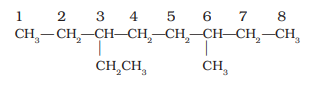
5. If the two substituents are found in equivalent positions, the lower number is given to the one coming first in the alphabetical listing. Thus, the following compound is 3-ethyl-6-methyloctane and not 6-ethyl-3-methyloctane.
6. The branched alkyl groups can be named by following the above mentioned procedures. However, the carbon atom of the branch that attaches to the root alkane is numbered 1 as exemplified below.
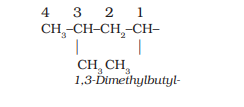
The name of such branched chain alkyl group is placed in parenthesis while naming the compound. While writing the trivial names of substituents’ in alphabetical order, the prefixes iso- and neo- are considered to be the part of the fundamental name of alkyl group. The prefixes sec- and tert- are not considered to be the part of the fundamental name. The use of iso and related common prefixes for naming alkyl groups is also allowed by the IUPAC nomenclature as long as these are not further substituted. In multisubstituted compounds, the following rules may aso be remembered:
If there happens to be two chains of equal size, then that chain is to be selected which contains more number of side chains.
After selection of the chain, numbering is to be done from the end closer to the substituent.
Cyclic Compounds: A saturated monocyclic compound is named by prefixing ‘cyclo’ to the corresponding straight chain alkane. If side chains are present, then the rules given above are applied. Names of some cyclic compounds are given below.

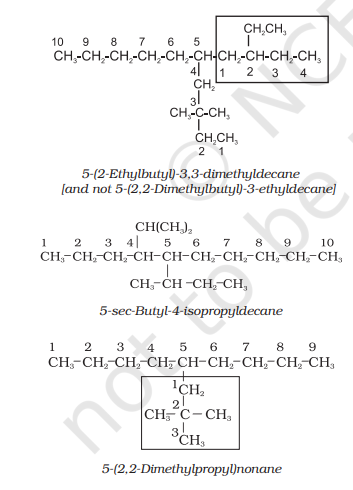
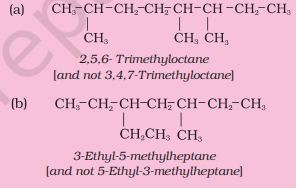
Structures and IUPAC names of some hydrocarbons are given below. Explain why the names given in the parentheses are incorrect.
Solution
(a) Lowest locant number, 2,5,6 is lower than 3,5,7, (b) substituents are in equivalent position; lower number is given to the one that comes first in the name according to alphabetical order.
12.5.3 Nomenclature of Organic Compounds having Functional Group(s)
A functional group, as defined earlier, is an atom or a group of atoms bonded together in a unique manner which is usually the site of
chemical reactivity in an organic molecule. Compounds having the same functional group undergo similar reactions. For example, $\mathrm{CH_3} \mathrm{OH}, \mathrm{CH_3} \mathrm{CH_2} \mathrm{OH}$, and $\left(\mathrm{CH_3}\right)_{2} \mathrm{CHOH}-$ all having – $\mathrm{OH}$ functional group liberate hydrogen on reaction with sodium metal. The presence of functional groups enables systematisation of organic compounds into different classes. Examples of some functional groups with their prefixes and suffixes along with some examples of organic compounds possessing these are given in Table 12.4.
First of all, the functional group present in the molecule is identified which determines the choice of appropriate suffix. The longest chain of carbon atoms containing the functional group is numbered in such a way that the functional group is attached at the carbon atom possessing lowest possible number in the chain. By using the suffix as given in Table 12.4, the name of the compound is arrived at.
In the case of polyfunctional compounds, one of the functional groups is chosen as the principal functional group and the compound is then named on that basis. The remaining functional groups, which are subordinate functional groups, are named as substituents using the appropriate prefixes. The choice of principal functional group is made on the basis of order of preference. The order of decreasing priority for some functional groups is:
$-\mathrm{COOH},-\mathrm{SO_3} \mathrm{H},-\mathrm{COOR} \text{(R=alkyl group)}, \mathrm{COCl}, -\mathrm{CONH_2},-\mathrm{CN},-\mathrm{HC}=\mathrm{O},>\mathrm{C}=\mathrm{O},-\mathrm{OH},-\mathrm{NH_2},> \mathbf{C}=\mathbf{C}<, \quad-\mathbf{C} \equiv \mathbf{C}-$.
The $-\mathrm{R}, \mathrm{C_6} \mathrm{H_5}-$, halogens ( $\left.\mathrm{F}, \mathrm{Cl}, \mathrm{Br}, \mathrm{I}\right),-\mathrm{NO_2}$, alkoxy (-OR) etc. are always prefix substituents. Thus, a compound containing both an alcohol and a keto group is named as hydroxyalkanone since the keto group is preferred to the hydroxyl group.
For example, $\mathrm{HOCH_2}\left(\mathrm{CH_2}\right)_{3} \mathrm{CH_2} \mathrm{COCH_3}$ will be named as 7-hydroxyheptan-2-one and not as 2-oxoheptan -7-ol. Similarly, $\mathrm{BrCH_2} \mathrm{CH}=\mathrm{CH_2}$ is named as 3-bromoprop-1-ene and not 1 -bromoprop-2-ene.
If more than one functional group of the same type are present, their number is indicated by adding di, tri, etc. before the class suffix. In such cases the full name of the parent alkane is written before the class suffix. For example $\mathrm{CH_2}(\mathrm{OH}) \mathrm{CH_2}(\mathrm{OH})$ is named as ethane-1,2-diol. However, the ending – ne of the parent alkane is dropped in the case of compounds having more than one double or triple bond; for example, $\mathrm{CH_2}=\mathrm{CH}-\mathrm{CH}=\mathrm{CH_2}$ is named as buta-1,3-diene.
Problem 12.8
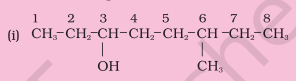
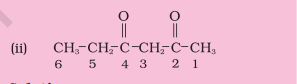
Write the IUPAC names of the compounds i-iv from their given structures.
Solution
The functional group present is an alcohol (OH). Hence the suffix is ‘-ol’.
The longest chain containing $-\mathrm{OH}$ has eight carbon atoms. Hence the corresponding saturated hydrocarbon is octane.
The $-\mathrm{OH}$ is on carbon atom 3. In addition, a methyl group is attached at $6^{\text {th }}$ carbon.
Hence, the systematic name of this compound is 6-Methyloctan-3-ol.
Solution
The functional group present is ketone ( $>\mathrm{C}=\mathrm{O}$ ), hence suffix ‘-one’. Presence of two keto groups is indicated by ‘di’, hence suffix becomes ‘dione’. The two keto groups are at carbons 2 and 4 . The longest chain contains 6 carbon atoms, hence, parent hydrocarbon is hexane. Thus, the systematic name is Hexane-2,4-dione.

Table 12.4 Some Functional Groups and Classes of Organic Compounds
| Class of compounds | Functional group structure | IUPAC group prefix | IUPAC group suffix | Example |
|---|---|---|---|---|
| Alkanes | – | – | -ane | Butane, $\mathrm{CH}_3\left(\mathrm{CH}_2\right)_2 \mathrm{CH}_3$ |
| Alkenes | $>\mathrm{C}=\mathrm{C}<$ | – | -ene | But-1-ene, $\mathrm{CH}_2=\mathrm{CHCH}_2 \mathrm{CH}_3$ |
| Alkynes | $-\mathrm{C} \equiv \mathrm{C}-$ | – | -yne | But-1-yne, $\mathrm{CH} \equiv \mathrm{CCH}_2 \mathrm{CH}_3$ |
| Arenes | – | – | – | Benzene  |
| Halides | $-\mathrm{X}$ $(\mathrm{X}=\mathrm{F}, \mathrm{Cl}, \mathrm{Br}, \mathrm{I})$ | halo- | – | 1-Bromobutane. $\mathrm{CH}_3\left(\mathrm{CH}_2\right)_2 \mathrm{CH}_2 \mathrm{Br}$ |
| Alcohols | $-\mathrm{OH}$ | hydroxy- | $-\mathrm{ol}$ | Butan-2-ol, |
| Aldehydes | $-\mathrm{CHO}$ | formyl, or oxo | Butanal, $\mathrm{CH}_3\left(\mathrm{CH}_2\right)_2 \mathrm{CHO}$ | |
| Ketones | $>\mathrm{C}=\mathrm{O}$ | Butan-2-one, $\mathrm{CH}_3 \mathrm{CH}_2 \mathrm{COCH}_3$ | ||
| Nitriles | $-\mathrm{C} \equiv \mathrm{N}$ | I | Pentanenitrile, $\mathrm{CH}_3 \mathrm{CH}_2 \mathrm{CH}_2 \mathrm{CH}_2 \mathrm{CN}$ | |
| Ethers | -R-O-R- | alko | Ethoxyethane, $\mathrm{CH}_3 \mathrm{CH}_2 \mathrm{OCH}_2 \mathrm{CH}_3$ | |
| Carboxylic acids | $-\mathrm{COOH}$ | carboxy | -oic acid | Butanoic acid, $\mathrm{CH}_3\left(\mathrm{CH}_2\right)_2 \mathrm{CO}_2 \mathrm{H}$ |
| Carboxylate ions | $-\mathrm{COO}^{-}$ | -oate | Sodium butanoate, $\mathrm{CH}_3\left(\mathrm{CH}_2\right)_2 \mathrm{CO}_2^{-} \mathrm{Na}^{+}$ | |
| Esters | -COOR | alkoxycarbonyl | -oate | Methyl propanoate, $\mathrm{CH}_3 \mathrm{CH}_2 \mathrm{COOCH}_3$ |
| Acyl halides | $-\mathrm{COX}$ $(\mathrm{X}=\mathrm{F}, \mathrm{Cl}, \mathrm{Br}, \mathrm{I})$ | halocarbonyl | -oyl halide | Butanoyl chloride, $\mathrm{CH}_3\left(\mathrm{CH}_2\right)_2 \mathrm{COCl}$ |
| Amines | $-\mathrm{NH}_2$, $>\mathrm{NH},>\mathrm{N}-$ | amino- | -amine | Butan-2-amine , $\mathrm{CH}_3 \mathrm{CHNH}_2 \mathrm{CH}_2 \mathrm{CH}_3$ |
| Amides | $-\mathrm{CONH}_2$, – $\mathrm{CONHR}$, – $\mathrm{CONR}_2$ | -carbamoyl | -amide | Butanamide, $\mathrm{CH}_3\left(\mathrm{CH}_2\right)_2 \mathrm{CONH}_2$ |
| Nitro compounds | $-\mathrm{NO}_2$ | nitro | – | 1-Nitrobutane, $\mathrm{CH}_3\left(\mathrm{CH}_2\right)_3 \mathrm{NO}_2$ |
| Sulphonic acids | $-\mathrm{SO}_3 \mathrm{H}$ | sulpho | sulphonic acid | Methylsulphonic acid $\mathrm{CH}_3 \mathrm{SO}_3 \mathrm{H}$ |
Here, two functional groups namely ketone and carboxylic acid are present. The principal functional group is the carboxylic acid group; hence the parent chain will be suffixed with ‘oic’ acid. Numbering of the chain starts from carbon of – $\mathrm{COOH}$ functional group. The keto group in the chain at carbon 5 is indicated by ‘oxo’. The longest chain including the principal functional group has 6 carbon atoms; hence the parent hydrocarbon is hexane. The compound is, therefore, named as 5-Oxohexanoic acid.
(iv) $\underset{6}{\mathrm{CH}} \equiv \underset{5}{\mathrm{C}}-\underset{4}{\mathrm{CH}}=\underset{3}{\mathrm{CH}}-\underset{2}{\mathrm{CH}}=\underset{1}{\mathrm{CH_2}} $
Solution
The two $\mathrm{C}=\mathrm{C}$ functional groups are present at carbon atoms 1 and 3, while the $\mathrm{C} \equiv \mathrm{C}$ functional group is present at carbon 5 . These groups are indicated by suffixes ‘diene’ and ‘yne’ respectively. The longest chain containing the functional groups has 6 carbon atoms; hence the parent hydrocarbon is hexane. The name of compound, therefore, is Hexa-1,3dien-5-yne.
Problem 12.9
Derive the structure of (i) 2-Chlorohexane, (ii) Pent-4-en-2-ol, (iii) 3-Nitrocyclohexene, (iv) Cyclohex-2-en-1-ol, (v) 6-Hydroxyheptanal.
Solution
(i) ‘hexane’ indicates the presence of 6 carbon atoms in the chain. The functional group chloro is present at carbon 2. Hence, the structure of the compound is $\mathrm{CH_3} \mathrm{CH_2} \mathrm{CH_2} \mathrm{CH_2} \mathrm{CH}(\mathrm{Cl}) \mathrm{CH_3}$.
(ii) ‘pent’ indicates that parent hydrocarbon contains 5 carbon atoms in the chain. ’en’ and ‘ol’ correspond to the functional groups $\mathrm{C}=\mathrm{C}$ and $-\mathrm{OH}$ at carbon atoms 4 and 2 respectively. Thus, the structure is $ \mathrm{CH_2}=\mathrm{CHCH_2} \mathrm{CH}(\mathrm{OH}) \mathrm{CH_3} . $
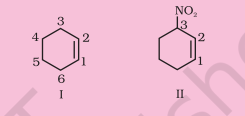
(iii) Six membered ring containing a carbon-carbon double bond is implied by cyclohexene, which is numbered as shown in (I). The prefix 3-nitro means that a nitro group is present on $\mathrm{C}-3$. Thus, complete structural formula of the compound is (II). Double bond is suffixed functional group whereas $\mathrm{NO_2}$ is prefixed functional group therefore double bond gets preference over $-\mathrm{NO_2}$ group:
(iv) ‘1-ol’ means that a – $\mathrm{OH}$ group is present at $\mathrm{C}-1$. OH is suffixed functional group and gets preference over $\mathrm{C}=\mathrm{C}$ bond. Thus the structure is as shown in (II):
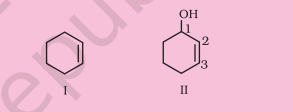
(v) ‘heptanal’ indicates the compound to be an aldehyde containing 7 carbon atoms in the parent chain. The ‘6-hydroxy’ indicates that – $\mathrm{OH}$ group is present at carbon 6 . Thus, the structural formula of the compound is: $\mathrm{CH_3} \mathrm{CH}(\mathrm{OH})$ $\mathrm{CH_2} \mathrm{CH_2} \mathrm{CH_2} \mathrm{CH_2} \mathrm{CHO}$. Carbon atom of $\mathrm{CHO}$ group is included while numbering the carbon chain.
12.5.4 Nomenclature of Substituted Benzene Compounds
For IUPAC nomenclature of substituted benzene compounds, the substituent is placed as prefix to the word benzene as shown in the following examples. However, common names (written in bracket below) of many substituted benzene compounds are also universally used.
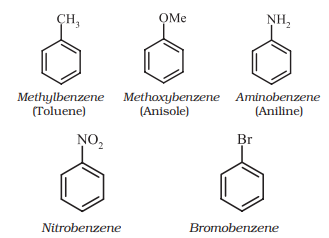
If benzene ring is disubstituted, the position of substituents is defined by numbering the carbon atoms of the ring such that the substituents are located at the lowest numbers possible. For example, the compound(b) is named as 1,3-dibromobenzene and not as 1,5-dibromobenzene.
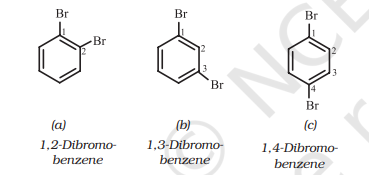
In the trivial system of nomenclature the terms ortho $(o)$ , meta $(\mathrm{m})$ and para $(p)$ are used as prefixes to indicate the relative positions 1,2;1,3 and 1,4 respectively. Thus, 1,3-dibromobenzene (b) is named as $m$-dibromobenzene (meta is abbreviated as $m$-) and the other isomers of dibromobenzene 1,2-(a) and 1,4-(c), are named as ortho (or just $o^{-}$) and para (or just $p$-)-dibromobenzene, respectively.
For tri – or higher substituted benzene derivatives, these prefixes cannot be used and the compounds are named by identifying substituent positions on the ring by following the lowest locant rule. In some cases, common name of benzene derivatives is taken as the base compound.
Substituent of the base compound is assigned number 1 and then the direction of numbering is chosen such that the next substituent gets the lowest number. The substituents appear in the name in alphabetical order. Some examples are given below.
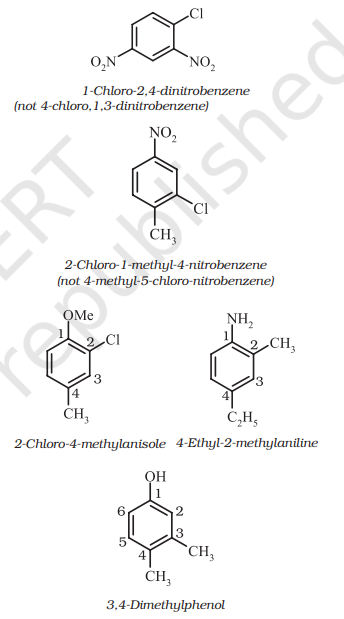
When a benzene ring is attached to an alkane with a functional group, it is considered as substituent, instead of a parent. The name for benzene as substituent is phenyl $\left(\mathrm{C_6} \mathrm{H_5}{ }^{-} \text{ , also abbreviated as } \mathrm{Ph} \right)$ .
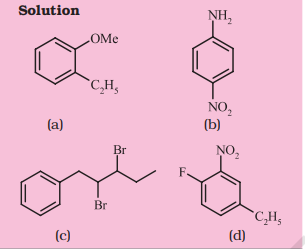
Problem 12.10
Write the structural formula of:
(a) o-Ethylanisole,
(b) $p$-Nitroaniline,
(c) 2,3-Dibromo – 1 – phenylpentane,
(d) 4-Ethyl-1-fluoro-2-nitrobenzene.
12.6 ISOMERISM
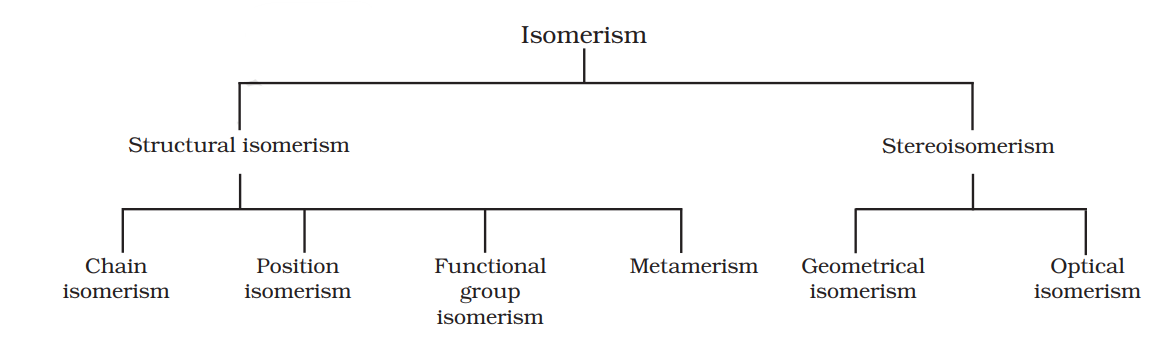
The phenomenon of existence of two or more compounds possessing the same molecular formula but different properties is known as isomerism. Such compounds are called as isomers. The following flow chart shows different types of isomerism.
12.6.1 Structural Isomerism
Compounds having the same molecular formula but different structures (manners in which atoms are linked) are classified as structural isomers. Some typical examples of different types of structural isomerism are given below:
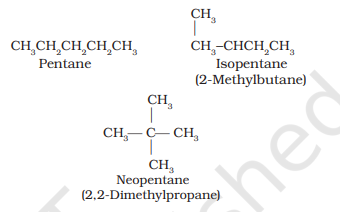
(i) Chain isomerism: When two or more compounds have similar molecular formula but different carbon skeletons, these are referred to as chain isomers and the phenomenon is termed as chain isomerism. For example, $\mathrm{C_5} \mathrm{H_{12}}$ represents three compounds:
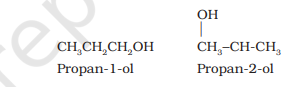
(ii) Position isomerism: When two or more compounds differ in the position of substituent atom or functional group on the carbon skeleton, they are called position isomers and this phenomenon is termed as position isomerism. For example, the alcohols:
(iii) Functional group isomerism: Two or more compounds having the same molecular formula but different functional groups are called functional isomers and this phenomenon is termed as functional group isomerism. For example, the molecular formula $\mathrm{C_3} \mathrm{H_6} \mathrm{O}$ represents an aldehyde and a ketone:
(iv) Metamerism: It arises due to different alkyl chains on either side of the functional group in the molecule. For example, $\mathrm{C_4} \mathrm{H_{10}} \mathrm{O}$ represents methoxypropane $\left(\mathrm{CH_3} \mathrm{OC_3} \mathrm{H_7}\right)$ and ethoxyethane $\left(\mathrm{C_2} \mathrm{H_5} \mathrm{OC_2} \mathrm{H_5}\right)$ .
12.6.2 Stereoisomerism
The compounds that have the same constitution and sequence of covalent bonds but differ in relative positions of their atoms or groups in space are called stereoisomers. This special type of isomerism is called as stereoisomerism and can be classified as geometrical and optical isomerism.
12.7 FUNDAMENTAL CONCEPTS IN ORGANIC REACTION MECHANISM
In an organic reaction, the organic molecule (also referred as a substrate) reacts with an appropriate attacking reagent and leads to the formation of one or more intermediate(s) and finally product(s)
The general reaction is depicted as follows :
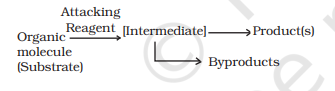
Substrate is that reactant which supplies carbon to the new bond and the other reactant is called reagent. If both the reactants supply carbon to the new bond then choice is arbitrary and in that case the molecule on which attention is focused is called substrate.
In such a reaction a covalent bond between two carbon atoms or a carbon and some other atom is broken and a new bond is formed. A sequential account of each step, describing details of electron movement, energetics during bond cleavage and bond formation, and the rates of transformation of reactants into products (kinetics) is referred to as reaction mechanism. The knowledge of reaction mechanism helps in understanding the reactivity of organic compounds and in planning strategy for their synthesis.
In the following sections, we shall learn some of the principles that explain how these reactions take place.
12.7.1 Fission of a Covalent Bond
A covalent bond can get cleaved either by : (i) heterolytic cleavage, or by (ii) homolytic cleavage.
In heterolytic cleavage, the bond breaks in such a fashion that the shared pair of electrons remains with one of the fragments.
After heterolysis, one atom has a sextet electronic structure and a positive charge and the other, a valence octet with at least one lone pair and a negative charge. Thus, heterolytic cleavage of bromomethane will give $\stackrel{+}{\mathrm{C}} \mathrm{H_3}$ and $\mathrm{Br}^{-}$as shown below.
$$
\mathrm{H} _{3} \mathrm{C} \overset \curvearrowright {- Br} \longrightarrow \mathrm{H} _{3} \stackrel{+}{\mathrm{C}}+\mathrm{Br}^{-}
$$
A species having a carbon atom possessing sextext of electrons and a positive charge is called a carbocation (earlier called carbonium ion). The $\stackrel{+}{\mathrm{C}} \mathrm{H_3}$ ion is known as a methyl cation or methyl carbonium ion. Carbocations are classified as primary, secondary or tertiary depending on whether one, two or three carbons are directly attached to the positively charged carbon. Some other examples of carbocations are: $\mathrm{CH_3} \stackrel{+}{\mathrm{C}} \mathrm{H_2}$ (ethyl cation, a primary carbocation), $\left(\mathrm{CH_3}\right)_2 \stackrel{+}{\mathrm{C}} \mathrm{H}$ (isopropyl cation, a secondary carbocation), and $\left(\mathrm{CH_3}\right)_3 \stackrel{+}{\mathrm{C}}$ (tert-butyl cation, a tertiary carbocation). Carbocations are highly unstable and reactive species. Alkyl groups directly attached to the positively charged carbon stabilise the carbocations due to inductive and hyperconjugation effects, which you will be studying in the sections 12.7.5 and 12.7.9. The observed order of carbocation stability is: $\stackrel{+}{\mathrm{C}} \mathrm{H_3}<\mathrm{CH_3} \stackrel{+}{\mathrm{C}} \mathrm{H_2}<\left(\mathrm{CH_3}\right)_2 \stackrel{+}{\mathrm{C}} \mathrm{H}<\left(\mathrm{CH_3}\right)_3 \stackrel{+}{\mathrm{C}}$. These carbocations have trigonal planar shape with positively charged carbon being $s p^{2}$ hybridised. Thus, the shape of $\stackrel{+}{\mathrm{C}} \mathrm{H_3}$ may be considered as being derived from the overlap of three equivalent $\mathrm{C}\left(s p^{2}\right)$ hybridised orbitals with $1 s$ orbital of each of the three hydrogen
atoms. Each bond may be represented as $\mathrm{C}\left(s p^{2}\right)-\mathrm{H}(1 s)$ sigma bond. The remaining carbon orbital is perpendicular to the molecular plane and contains no electrons. [Fig. 12.3(a)].
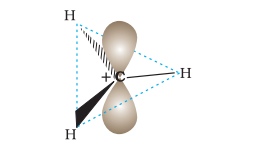
Fig. 12.3 (a) Shape of methyl carbocation
The heterolytic cleavage can also give a species in which carbon gets the shared pair of electrons. For example, when group $\mathrm{Z}$ attached to the carbon leaves without
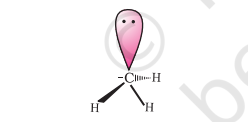
electron pair, the methyl anion $\left(\mathrm{H_3} \mathrm{C} \overline {:} \right)$ is formed. Such a carbon species carrying a negative charge on carbon atom is called carbanion. Carbon in carbanion is generally $\mathrm{sp}^{3}$ hybridised and its structure is distorted tetrahedron as shown in Fig. 12.3(b).

Fig. 12.3 (b) Shape of methyl carbanion
Carbanions are also unstable and reactive species. The organic reactions which proceed through heterolytic bond cleavage are called ionic or heteropolar or just polar reactions. In homolytic cleavage, one of the electrons of the shared pair in a covalent bond goes with each of the bonded atoms. Thus, in homolytic cleavage, the movement of a single electron takes place instead of an electron pair. The single electron movement is shown by ‘half-headed’ (fish hook: $\rightharpoonup$) curved arrow. Such cleavage results in the formation of neutral species (atom or group) which contains an unpaired electron. These species are called free radicals. Like carbocations and carbanions, free radicals are also very reactive. A homolytic cleavage can be shown as:
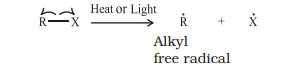
Alkyl radicals are classified as primary, secondary, or tertiary. Alkyl radical stability increases as we proceed from primary to tertiary:
$ \underset{\substack{\text{Methyl} \\ \substack{ \text{free} \\ \text{radical}}}}{\dot{\mathrm{C}} \mathrm{H_3}} < \underset{\substack{\text{Ethyl} \\ \substack{ \text{free} \\ \text{radical}}}}{\dot{\mathrm{C}} \mathrm{H_2} \mathrm{CH_3}} < \underset{\substack{\text{Isopropyl} \\ \substack{ \text{free} \\ \text{radical}}}}{\dot{\mathrm{C}} \mathrm{H} \left(\mathrm{CH_3} \right)_2} < \underset{\substack{\text{Tert-butyl} \\ \substack{ \text{free} \\ \text{radical}}}}{\dot{\mathrm{C}} \left(\mathrm{CH_3}\right)_3}$
Organic reactions, which proceed by homolytic fission are called free radical or homopolar or nonpolar reactions.
12.7.2 Substrate and Reagent
Ions are generally not formed in the reactions of organic compounds. Molecules as such participate in the reaction. It is convenient to name one reagent as substrate and other as reagent. In general, a molecule whose carbon is involved in new bond formation is called substrate and the other one is called reagent. When carbon-carbon bond is formed, the choice of naming the reactants as substrate and reagent is arbitrary and depends on molecule under observation. Example:

Nucleophiles and Electrophiles
Reagents attack the reactive site of the substrate. The reactive site may be electron
deficient portion of the molecule (a positive reactive site) e.g., an atom with incomplete electron shell or the positive end of the dipole in the molecule. If the attacking species is electron rich, it attacks these sites. If attacking species is electron deficient, the reactive site for it is that part of the substrate molecule which can supply electrons, e.g., $\pi$ electrons in a double bond.
A reagent that brings an electron pair to the reactive site is called a nucleophile (Nu:) i.e., nucleus seeking and the reaction is then called nucleophilic. A reagent that takes away an electron pair from reactive site is called electrophile $\left(\mathrm{E}^{+}\right)$ i.e., electron seeking and the reaction is called electrophilic.
During a polar organic reaction, a nucleophile attacks an electrophilic centre of the substrate which is that specific atom or part of the substrate which is electron deficient. Similarly, the electrophiles attack at nucleophilic centre, which is the electron rich centre of the substrate. Thus, the electrophiles receive electron pair from the substrate when the two undergo bonding interaction. A curved-arrow notation is used to show the movement of an electron pair from the nucleophile to the electrophile. Some examples of nucleophiles are the negatively charged ions with lone pair of electrons such as hydroxide $\left(\mathrm{HO}^{-}\right)$ , cyanide $\left(\mathrm{NC}^{-}\right)$ ions and carbanions $\left(\mathrm{R_3} \mathrm{C} \mathrm{C}^{-}\right)$ . Neutral molecules such as $\mathrm{H_2} \ddot{\mathrm{O}}:, \mathrm{R_3} \mathrm{~N}$ :, $\mathrm{R_2} \ddot{\mathrm{N}} \mathrm{H}$ etc., can also act as nucleophiles due to the presence of lone pair of electrons. Examples of electrophiles include carbocations $\left(\stackrel{\stackrel{+}{C}}{} \mathrm{H_3}\right)$ and neutral molecules having functional groups like carbonyl group ( $>\mathrm{C}=\mathrm{O})$ or alkyl halides $\left(\mathrm{R_3} \mathrm{C}-\mathrm{X}\right.$, where $\mathrm{X}$ is a halogen atom). The carbon atom in carbocations has sextet configuration; hence, it is electron deficient and can receive a pair of electrons from the nucleophiles. In neutral molecules such as alkyl halides, due to the polarity of the $\mathrm{C}-\mathrm{X}$ bond a partial positive charge is generated on the carbon atom and hence the carbon atom becomes an electrophilic centre at which a nucleophile can attack.
Problem 12.11
Using curved-arrow notation, show the formation of reactive intermediates when the following covalent bonds undergo heterolytic cleavage.
(a) $\mathrm{CH_3}-\mathrm{SCH_3}$, (b) $\mathrm{CH_3}-\mathrm{CN}$, (c) $\mathrm{CH_3}-\mathrm{Cu}$
Solution
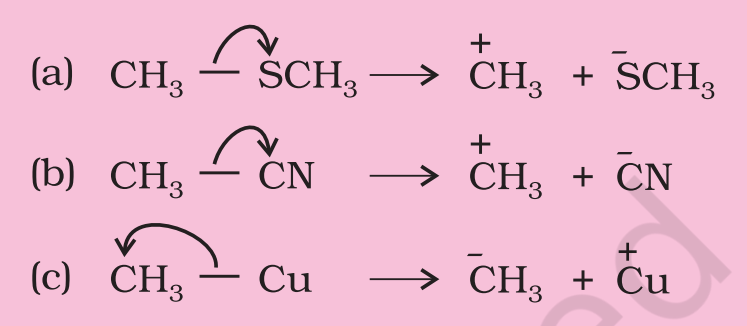
Problem 12.12
Giving justification, categorise the following molecules/ions as nucleophile or electrophile:
$\mathrm{HS}^{-}, \mathrm{BF_3}, \mathrm{C_2} \mathrm{H_5} \mathrm{O}^{-},\left(\mathrm{CH_3}\right)_{3} \mathrm{~N:}$,
${C} \stackrel{+}{1} , \mathrm{CH_3} \stackrel{+}{\mathrm{C}}=\mathrm{O}, \mathrm{H_2} \mathrm{~N:^-} , \stackrel{+}{\mathrm{N}} \mathrm{O_2}$
Solution
Nucleophiles: $\mathrm{HS}^{-}, \mathrm{C_2} \mathrm{H_5} \mathrm{O}^{-},\left(\mathrm{CH_3}\right)_{3} \mathrm{~N}: \mathrm{H_2} \mathrm{~N}^{-}$ These species have unshared pair of electrons, which can be donated and shared with an electrophile.
Electrophiles: $\mathrm{BF_3}, \mathrm{C} \stackrel{+}{1} \mathrm{H_3}-\stackrel{+}{\mathrm{C}}=\mathrm{O}, \stackrel{+}{\mathrm{N}} \mathrm{O_2}$. Reactive sites have only six valence electrons; can accept electron pair from a nucleophile.
Problem 12.13
Identify electrophilic centre in the following: $\mathrm{CH_3} \mathrm{CH}=\mathrm{O}, \mathrm{CH_3} \mathrm{CN}, \mathrm{CH_3} \mathrm{I}$.
Solution
Among $\mathrm{CH_3} \mathrm{H} \stackrel{*}{\mathrm{C}}=\mathrm{O}, \mathrm{H_3} \mathrm{C} \stackrel{\ast}{\mathrm{C}} \equiv \mathrm{N}$, and $\mathrm{H_3} \mathrm{C}^\ast-\mathrm{I}$,, the starred carbon atoms are electrophilic centers as they will have partial positive charge due to polarity of the bond.
12.7.3 Electron Movement in Organic Reactions
The movement of electrons in organic reactions can be shown by curved-arrow notation. It shows how changes in bonding occur due to electronic redistribution during the reaction. To show the change in position of a pair of electrons, curved arrow starts from the point from where an electron pair is shifted and it ends at a location to which the pair of electron may move.
Presentation of shifting of electron pair is given below :
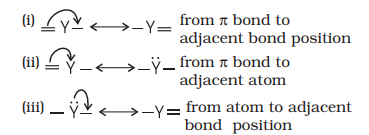
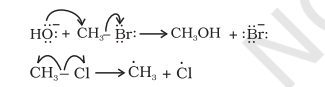
Movement of single electron is indicated by a single barbed ‘fish hooks’ (i.e. half headed curved arrow). For example, in transfer of hydroxide ion giving ethanol and in the dissociation of chloromethane, the movement of electron using curved arrows can be depicted as follows:
12.7.4 Electron Displacement Effects in Covalent Bonds
The electron displacement in an organic molecule may take place either in the ground state under the influence of an atom or a substituent group or in the presence of an appropriate attacking reagent. The electron displacements due to the influence of an atom or a substituent group present in the molecule cause permanent polarlisation of the bond. Inductive effect and resonance effects are examples of this type of electron displacements. Temporary electron displacement effects are seen in a molecule when a reagent approaches to attack it. This type of electron displacement is called electromeric effect or polarisability effect. In the following sections we will learn about these types of electronic displacements.
12.7.5 Inductive Effect
When a covalent bond is formed between atoms of different electronegativity, the electron density is more towards the more electronegative atom of the bond. Such a shift of electron density results in a polar covalent bond. Bond polarity leads to various electronic effects in organic compounds. Let us consider cholorethane $\left(\mathrm{CH_3} \mathrm{CH_2} \mathrm{Cl}\right)$ in which the $\mathrm{C}-\mathrm{Cl}$ bond is a polar covalent bond. It is polarised in such a way that the carbon-1 gains some positive charge $\left(\delta^{+}\right)$ and the chlorine some negative charge ( $\delta^{-}$). The fractional electronic charges on the two atoms in a polar covalent bond are denoted by symbol $\delta$ (delta) and the shift of electron density is shown by an arrow that points from $\delta^{+}$to $\delta^{-}$end of the polar bond.
$\stackrel{\delta \delta^+}{\underset{2}{\mathrm{CH_3}}} \xrightarrow{}— \stackrel{\delta^+}{\underset{1}{\mathrm{CH_2}}} \xrightarrow{}— \stackrel{\delta^-}{\mathrm{Cl}}$
In turn carbon-1, which has developed partial positive charge $\left(\delta^{+}\right)$ draws some electron density towards it from the adjacent $\mathrm{C}-\mathrm{C}$ bond. Consequently, some positive charge $\left(\delta \delta^{+}\right)$ develops on carbon- 2 also, where $\delta \delta^{+}$ symbolises relatively smaller positive charge as compared to that on carbon – 1 . In other words, the polar $\mathrm{C}-\mathrm{Cl}$ bond induces polarity in the adjacent bonds. Such polarisation of $\sigma$-bond caused by the polarisation of adjacent $\sigma$-bond is referred to as the inductive effect. This effect is passed on to the subsequent bonds also but the effect decreases rapidly as the number of intervening bonds increases and becomes vanishingly small after three bonds. The inductive effect is related to the ability of substituent(s) to either withdraw or donate electron density to the attached carbon atom. Based on this ability, the substitutents can be classified as electron-withdrawing or electron donating groups relative to hydrogen. Halogens and many other groups such as nitro $\left(-\mathrm{NO_2}\right)$ , cyano (- $\mathrm{CN}$ ), carboxy (- $\left.\mathrm{COOH}\right)$ , ester (COOR), aryloxy (-OAr, e.g. $-\mathrm{OC_6} \mathrm{H_5}$ ), etc. are electron-withdrawing groups. On the other hand, the alkyl groups like methyl $\left(-\mathrm{CH_3}\right)$ and ethyl $\left(-\mathrm{CH_2}-\mathrm{CH_3}\right)$ are usually considered as electron donating groups.
Problem 12.14
Which bond is more polar in the following pairs of molecules: (a) $\mathrm{H_3} \mathrm{C}-\mathrm{H}, \mathrm{H_3} \mathrm{C}-\mathrm{Br}$ (b) $\mathrm{H_3} \mathrm{C}-\mathrm{NH_2}, \mathrm{H_3} \mathrm{C}-\mathrm{OH}$ (c) $\mathrm{H_3} \mathrm{C}-\mathrm{OH}$, $\mathrm{H_3} \mathrm{C}$-SH
Solution
(a) $\mathrm{C}-\mathrm{Br}$, since $\mathrm{Br}$ is more electronegative than $\mathrm{H}$, (b) $\mathrm{C}-\mathrm{O}$, (c) $\mathrm{C}-\mathrm{O}$
Problem 12.15
In which $\mathrm{C}-\mathrm{C}$ bond of $\mathrm{CH_3} \mathrm{CH_2} \mathrm{CH_2} \mathrm{Br}$, the inductive effect is expected to be the least?
Solution
Magnitude of inductive effect diminishes as the number of intervening bonds increases. Hence, the effect is least in the bond between carbon-3 and hydrogen.
12.7.6 Resonance Structure
There are many organic molecules whose behaviour cannot be explained by a single Lewis structure. An example is that of benzene. Its cyclic structure containing alternating $\mathrm{C}-\mathrm{C}$ single and $\mathrm{C}=\mathrm{C}$ double bonds shown is inadequate for explaining its Benzene characteristic properties.
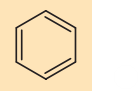
As per the above representation, benzene should exhibit two different bond lengths, due to $\mathrm{C}-\mathrm{C}$ single and $\mathrm{C}=\mathrm{C}$ double bonds. However, as determined experimentally benzene has a uniform $\mathrm{C}-\mathrm{C}$ bond distances of $139 \mathrm{pm}$, a value intermediate between the $\mathrm{C}-\mathrm{C}$ single $(154 \mathrm{pm}$ ) and $\mathrm{C}=\mathrm{C}$ double (134 $\mathrm{pm}$ ) bonds. Thus, the structure of benzene cannot be represented adequately by the above structure. Further, benzene can be represented equally well by the energetically identical structures I and II.

Therefore, according to the resonance theory (Unit 4) the actual structure of benzene cannot be adequately represented by any of these structures, rather it is a hybrid of the two structures (I and II) called resonance structures. The resonance structures (canonical structures or contributing structures) are hypothetical and individually do not represent any real molecule. They contribute to the actual structure in proportion to their stability.
Another example of resonance is provided by nitromethane $\left(\mathrm{CH_3} \mathrm{NO_2}\right)$ which can be represented by two Lewis structures, (I and II). There are two types of $\mathrm{N}-\mathrm{O}$ bonds in these structures.
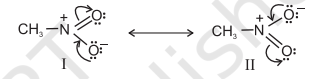
However, it is known that the two $\mathrm{N}-\mathrm{O}$ bonds of nitromethane are of the same length (intermediate between a $\mathrm{N}-\mathrm{O}$ single bond and a $\mathrm{N}=\mathbf{O}$ double bond). The actual structure of nitromethane is therefore a resonance hybrid of the two canonical forms I and II.
The energy of actual structure of the molecule (the resonance hybrid) is lower than that of any of the canonical structures. The difference in energy between the actual structure and the lowest energy resonance structure is called the resonance stabilisation energy or simply the resonance energy. The more the number of important contributing structures, the more is the resonance energy. Resonance is particularly important when the contributing structures are equivalent in energy.
The following rules are applied while writing resonance structures:
The resonance structures have (i) the same positions of nuclei and (ii) the same number of unpaired electrons. Among the resonance structures, the one which has more number of covalent bonds, all the atoms with octet of electrons (except hydrogen which has a duplet), less separation of opposite charges, (a negative charge if any on more electronegative atom, a positive charge if any on more electropositive atom) and more dispersal of charge, is more stable than others.
Problem 12.16
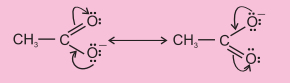
Write resonance structures of $\mathrm{CH_3} \mathrm{COO}^{-}$ and show the movement of electrons by curved arrows.
Solution
First, write the structure and put unshared pairs of valence electrons on appropriate atoms. Then draw the arrows one at a time moving the electrons to get the other structures.
Problem 12.17
Write resonance structures of $\mathrm{CH_2}=\mathrm{CH}-\mathrm{CHO}$. Indicate relative stability of the contributing structures.
Solution
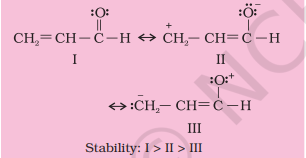
[I: Most stable, more number of covalent bonds, each carbon and oxygen atom has an octet and no separation of opposite charge II: negative charge on more electronegative atom and positive charge on more electropositive atom; III: does not contribute as oxygen has positive charge and carbon has negative charge, hence least stable].
Problem 12.18
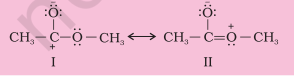
Explain why the following two structures, I and II cannot be the major contributors to the real structure of $\mathrm{CH_3} \mathrm{COOCH_3}$.
Solution
The two structures are less important contributors as they involve charge separation. Additionally, structure I contains a carbon atom with an incomplete octet.
12.7.7 Resonance Effect
The resonance effect is defined as ’the polarity produced in the molecule by the interaction of two $\pi$-bonds or between a $\pi$-bond and lone pair of electrons present on an adjacent atom’. The effect is transmitted through the chain. There are two types of resonance or mesomeric effect designated as $\mathrm{R}$ or $\mathrm{M}$ effect.
(i) Positive Resonance Effect ( $+R$ effect)
In this effect, the transfer of electrons is away from an atom or substituent group attached to the conjugated system. This electron displacement makes certain positions in the molecule of high electron densities. This effect in aniline is shown as :

(ii) Negative Resonance Effect (- $\boldsymbol{R}$ effect)
This effect is observed when the transfer of electrons is towards the atom or substituent group attached to the conjugated system. For example in nitrobenzene this electron displacement can be depicted as :
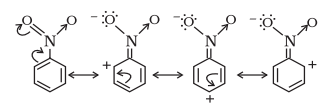
The atoms or substituent groups, which represent $+\mathrm{R}$ or $-\mathrm{R}$ electron displacement effects are as follows :
+R effect: – halogen, – $\mathrm{OH},-\mathrm{OR},-\mathrm{OCOR},-\mathrm{NH_2}$, $-\mathrm{NHR},-\mathrm{NR_2}$, -NHCOR,
R effect: $-\mathrm{COOH},-\mathrm{CHO},>\mathrm{C}=\mathrm{O},-\mathrm{CN},-\mathrm{NO_2}$
The presence of alternate single and double bonds in an open chain or cyclic system is termed as a conjugated system. These systems often show abnormal behaviour. The examples are 1,3- butadiene, aniline and nitrobenzene etc. In such systems, the $\pi$-electrons are delocalised and the system develops polarity.
12.7.8 Electromeric Effect (E effect)
It is a temporary effect. The organic compounds having a multiple bond (a double or triple bond) show this effect in the presence of an attacking reagent only. It is defined as the complete transfer of a shared pair of $\pi$-electrons to one of the atoms joined by a multiple bond on the demand of an attacking reagent. The effect is annulled as soon as the attacking reagent is removed from the domain of the reaction. It is represented by $\mathrm{E}$ and the shifting of the electrons is shown by a curved arrow $(\curvearrowright)$ . There are two distinct types of electromeric effect.
(i) Positive Eelctromeric Effect (+E effect) In this effect the $\pi$-electrons of the multiple bond are transferred to that atom to which the reagent gets attached. For example:

(ii) Negative Electromeric Effect (-E effect) In this effect the $\pi$ – electrons of the multiple bond are transferred to that atom to which the attacking reagent does not get attached. For example:
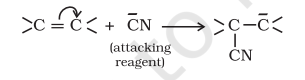
When inductive and electromeric effects operate in opposite directions, the electomeric effect predominates.
12.7.9 Hyperconjugation
Hyperconjugation is a general stabilising interaction. It involves delocalisation of $\sigma$ electrons of $\mathrm{C}-\mathrm{H}$ bond of an alkyl group directly attached to an atom of unsaturated system or to an atom with an unshared $p$ orbital. The $\sigma$ electrons of $\mathrm{C}-\mathrm{H}$ bond of the alkyl group enter into partial conjugation with the attached unsaturated system or with the unshared $p$ orbital. Hyperconjugation is a permanent effect.
To understand hyperconjugation effect, let us take an example of $\mathrm{CH_3} \stackrel{+}{\mathrm{C}} \mathrm{H_2}$ (ethyl cation) in which the positively charged carbon atom has an empty $p$ orbital. One of the $\mathrm{C}-\mathrm{H}$ bonds of the methyl group can align in the plane of this empty $p$ orbital and the electrons constituting the $\mathrm{C}-\mathrm{H}$ bond in plane with this $p$ orbital can then be delocalised into the empty $p$ orbital as depicted in Fig. 12.4 (a).

Fig. 12.4(a) Orbital diagram showing hyperconjugation in ethyl cation
This type of overlap stabilises the carbocation because electron density from the adjacent $\sigma$ bond helps in dispersing the positive charge.

In general, greater the number of alkyl groups attached to a positively charged carbon atom, the greater is the hyperconjugation interaction and stabilisation of the cation. Thus, we have the following relative stability of carbocations
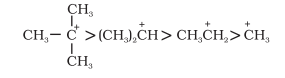
Hyperconjugation is also possible in alkenes and alkylarenes.
Delocalisation of electrons by hyperconjugation in the case of alkene can be depicted as in Fig. 12.4(b).
Fig. 12.4(b) Orbital diagram showing hyperconjugation in propene
There are various ways of looking at the hyperconjugative effect. One of the way is to regard $\mathrm{C}-\mathrm{H}$ bond as possessing partial ionic character due to resonance.
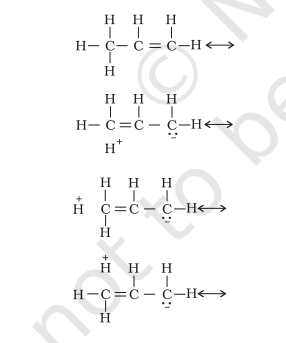
The hyperconjugation may also be regarded as no bond resonance.
Problem 12.19
Explain why $\left(\mathrm{CH_3}\right)_3 \stackrel{+}{\mathrm{C}}$ is more stable than $\mathrm{CH_3} \stackrel{+}{\mathrm{C}} \mathrm{H_2}$ and $\stackrel{+}{\mathrm{C}} \mathrm{H_3}$ is the least stable cation.
Solution
Hyperconjugation interaction in $\left(\mathrm{CH_3}\right)_3 \stackrel{+}{\mathrm{C}}$ is greater than in $\mathrm{CH_3} \stackrel{+}{\mathrm{C}} \mathrm{H_2}$ as the $\left(\mathrm{CH_3}\right)_3 \stackrel{+}{\mathrm{C}}$ has nine $\mathrm{C}-\mathrm{H}$ bonds. In $\stackrel{+}{\mathrm{C}} \mathrm{H_3}$, vacant $p$ orbital is perpendicular to the plane in which $\mathrm{C}-\mathrm{H}$ bonds lie; hence cannot overlap with it. Thus, $\stackrel{+}{\mathrm{C}} \mathrm{H_3}$ lacks hyperconjugative stability.
12.7.10 Types of Organic Reactions and Mechanisms
Organic reactions can be classified into the following categories:
(i) Substitution reactions
(ii) Addition reactions
(iii) Elimination reactions
(iv) Rearrangement reactions
You will be studying these reactions in Unit 9 and later in class XII.
12.8 METHODS OF PURIFICATION OF ORGANIC COMPOUNDS
Once an organic compound is extracted from a natural source or synthesised in the laboratory, it is essential to purify it. Various methods used for the purification of organic compounds are based on the nature of the compound and the impurity present in it.
The common techniques used for purification are as follows :
(i) Sublimation
(ii) Crystallisation
(iii) Distillation
(iv) Differential extraction and
(v) Chromatography
Finally, the purity of a compound is ascertained by determining its melting or boiling point. Most of the pure compounds have sharp melting points and boiling points. New methods of checking the purity of an organic compound are based on different
types of chromatographic and spectroscopic techniques.
12.8.1 Sublimation
You have learnt earlier that on heating, some solid substances change from solid to vapour state without passing through liquid state. The purification technique based on the above principle is known as sublimation and is used to separate sublimable compounds from nonsublimable impurities.
12.8.2 Crystallisation
This is one of the most commonly used techniques for the purification of solid organic compounds. It is based on the difference in the solubilities of the compound and the impurities in a suitable solvent. The impure compound is dissolved in a solvent in which it is sparingly soluble at room temperature but appreciably soluble at higher temperature. The solution is concentrated to get a nearly saturated solution. On cooling the solution, pure compound crystallises out and is removed by filtration. The filtrate (mother liquor) contains impurities and small quantity of the compound. If the compound is highly soluble in one solvent and very little soluble in another solvent, crystallisation can be satisfactorily carried out in a mixture of these solvents. Impurities, which impart colour to the solution are removed by adsorbing over activated charcoal. Repeated crystallisation becomes necessary for the purification of compounds containing impurities of comparable solubilities.
12.8.3 Distillation
This important method is used to separate (i) volatile liquids from nonvolatile impurities and (ii) the liquids having sufficient difference in their boiling points. Liquids having different boiling points vaporise at different temperatures. The vapours are cooled and the liquids so formed are collected separately. Chloroform (b.p $334 \mathrm{~K}$ ) and aniline (b.p. 457 K) are easily separated by the technique of distillation (Fig 8.5). The liquid mixture is taken in a round bottom flask and heated carefully. On boiling, the vapours of lower boiling component are formed first. The vapours are condensed by using a condenser and the liquid is collected in a receiver. The vapours of higher boiling component form later and the liquid can be collected separately.

Fig.8.5 Simple distillation. The vapours of a substance formed are condensed and the liquid is collected in conical flask.
Fractional Distillation: If the difference in boiling points of two liquids is not much, simple distillation cannot be used to separate them. The vapours of such liquids are formed within the same temperature range and are condensed simultaneously. The technique of fractional distillation is used in such cases. In this technique, vapours of a liquid mixture are passed through a fractionating column before condensation. The fractionating column is fitted over the mouth of the round bottom flask (Fig.12.6).
Vapours of the liquid with higher boiling point condense before the vapours of the liquid with lower boiling point. The vapours rising up in the fractionating column become richer in more volatile component. By the time the vapours reach to the top of the fractionating column, these are rich in the more volatile component. Fractionating columns are available in various sizes and designs as shown in Fig.12.7. A fractionating column provides many surfaces for heat exchange between the ascending vapours and the descending condensed liquid. Some of the condensing liquid in the fractionating column obtains heat from the ascending vapours and revaporises. The vapours thus become richer in low boiling component. The vapours of low boiling component ascend to the top of the column. On reaching the top, the vapours become pure in low boiling component and pass through the condenser and the pure liquid is collected in a receiver. After a series of successive distillations, the remaining liquid in the distillation flask gets enriched in high boiling component. Each successive condensation and vaporisation unit in the fractionating column is called a theoretical plate. Commercially, columns with hundreds of plates are available.

Fig.8.6 Fractional distillation. The vapours of lower boiling fraction reach the top of the column first followed by vapours of higher boiling fractions.
One of the technological applications of fractional distillation is to separate different crude oil in petroleum industry. Distillation under reduced pressure: This method is used to purify liquids having very high boiling points and those, which decompose at or below their boiling points. Such liquids are made to boil at a temperature lower than their normal boiling points by reducing the pressure on their surface. A liquid boils at a temperature at which its vapour pressure is equal to the external pressure. The pressure is reduced with the help of a water pump or vacuum pump (Fig.8.8). Glycerol can be separated from spent-lye in soap industry by using this technique.
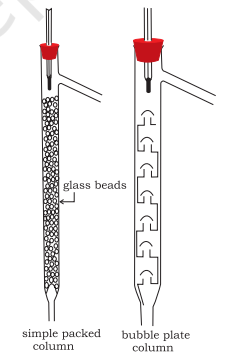
Fig.8.7 Different types of fractionating columns.
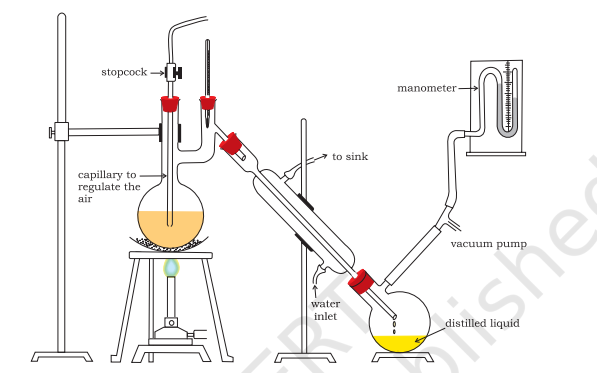
Fig.8.8 Distillation under reduced pressure. A liquid boils at a temperature below its
vapour pressure by reducing the pressure
Steam Distillation: This technique is applied to separate substances which are steam volatile and are immiscible with water. In steam distillation, steam from a steam generator is passed through a heated flask containing the liquid to be distilled. The mixture of steam and the volatile organic compound is condensed and collected. The compound is later separated from water using a separating funnel. In steam distillation, the liquid boils when the sum of vapour pressures due to the organic liquid $\left(p_{1}\right)$ and that due to water $\left(p_{2}\right)$ becomes equal to the atmospheric pressure (p), i.e. $p=p_{1}+p_{2}$. Since $p_{1}$ is lower than $p$, the organic liquid vaporises at lower temperature than its boiling point.
Thus, if one of the substances in the mixture is water and the other, a water insoluble substance, then the mixture will boil close to but below, 373K. A mixture of water and the substance is obtained which can be separated by using a separating funnel. Aniline is separated by this technique from aniline – water mixture (Fig.12.9,).
12.8.4 Differential Extraction
When an organic compound is present in an aqueous medium, it is separated by shaking it with an organic solvent in which it is more soluble than in water. The organic solvent and the aqueous solution should be immiscible with each other so that they form two distinct layers which can be separated by separatory funnel. The organic solvent is later removed by distillation or by evaporation to get back the compound. Differential extraction is carried out in a separatory funnel as shown in Fig. 12.10 (Page 282). If the organic compound is less soluble in the organic solvent, a very large quantity of solvent would be required to extract even a very small quantity of the compound. The technique of continuous extraction is employed in such cases. In this technique same solvent is repeatedly used for extraction of the compound.
12.8.5 Chromatography
Chromatography is an important technique extensively used to separate mixtures into their components, purify compounds and also to test the purity of compounds. The name chromatography is based on the Greek word chroma, for colour since the method was first used for the separation of coloured substances found in plants. In this technique, the mixture of substances is applied onto a stationary phase, which may be a solid or a liquid. A pure solvent, a mixture of solvents, or a gas is allowed to move slowly over the stationary phase. The components of the mixture get gradually separated from one another. The moving phase is called the mobile phase.
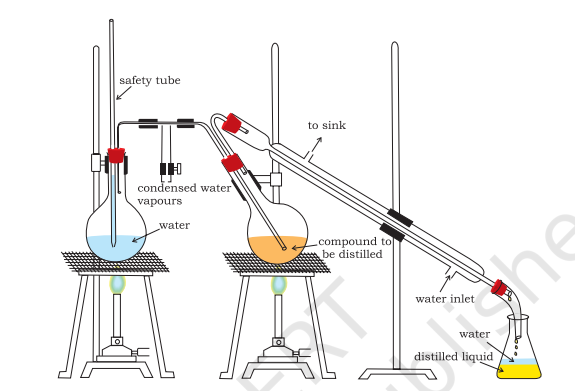
Fig.8.9 Steam distillation. Steam volatile component volatilizes, the vapours condense
in the condenser and the liquid collects in conical flask.
Based on the principle involved, chromatography is classified into different categories. Two of these are:
(a) Adsorption chromatography, and
(b) Partition chromatography.
a) Adsorption Chromatography: Adsorption chromatography is based on the fact that different compounds are adsorbed on an adsorbent to different degrees. Commonly used adsorbents are silica gel and alumina. When a mobile phase is allowed to move over a stationary phase (adsorbent), the components of the mixture move by varying distances over the stationary phase. Following are two main types of chromatographic techniques based on the principle of differential adsorption.
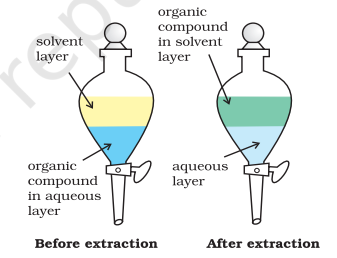
Fig.8.10 Differential extraction. Extraction of compound takes place based on difference
in solubility
(a) Column chromatography, and
(b) Thin layer chromatography.
Column Chromatography: Column chromatography involves separation of a mixture over a column of adsorbent (stationary phase) packed in a glass tube. The column is fitted with a stopcock at its lower end (Fig. 12.11). The mixture adsorbed on adsorbent is placed on the top of the adsorbent column packed in a glass tube. An appropriate eluant which is a liquid or a mixture of liquids is allowed to flow down the column slowly. Depending upon the degree to which the compounds are adsorbed, complete separation takes place. The most readily adsorbed substances are retained near the top and others come down to various distances in the column (Fig.12.11).
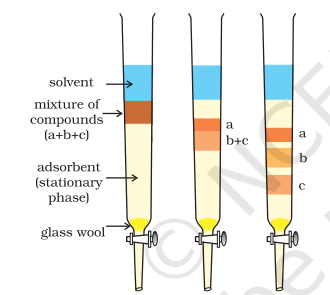
Fig.8.11 Column chromatography. Different stages of separation of components of a mixture.
Thin Layer Chromatography: Thin layer chromatography (TLC) is another type of adsorption chromatography, which involves separation of substances of a mixture over a thin layer of an adsorbent coated on glass plate. A thin layer (about $0.2 \mathrm{~mm}$ thick) of an adsorbent (silica gel or alumina) is spread over a glass plate of suitable size. The plate is known as thin layer chromatography plate or chromaplate. The solution of the mixture to be separated is applied as a small spot about $2 \mathrm{~cm}$ above one end of the TLC plate.
The glass plate is then placed in a closed jar containing the eluant (Fig. 12.12a). As the eluant rises up the plate, the components of the mixture move up along with the eluant to different distances depending on their degree of adsorption and separation takes place. The relative adsorption of each component of the mixture is expressed in terms of its retardation factor i.e. $\mathbf{R_f}$ value (Fig.8.12 b).
$$R_f = \dfrac{\text{Distance moved by the substance from base line(x)}}{\text{Distance moved by the solvent from base line(y)}}$$

Fig.8.12 (a) Thin layer chromatography. Chromatogram being developed.
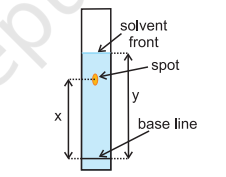
Fig.8.12 (b) Developed chromatogram
The spots of coloured compounds are visible on TLC plate due to their original colour. The spots of colourless compounds, which are invisible to the eye but fluoresce in ultraviolet light, can be detected by putting the plate under ultraviolet light. Another detection technique is to place the plate in a covered jar containing a few crystals of iodine. Spots of compounds, which adsorb iodine, will show up as brown spots. Sometimes an appropriate reagent may also be sprayed on the plate. For example, amino acids may be detected by spraying the plate with ninhydrin solution (Fig.8.12b).
Partition Chromatography: Partition chromatography is based on continuous differential partitioning of components of a mixture between stationary and mobile phases. Paper chromatography is a type of partition chromatography. In paper chromatography, a special quality paper known as chromatography paper is used. Chromatography paper contains water trapped in it, which acts as the stationary phase.
A strip of chromatography paper spotted at the base with the solution of the mixture is suspended in a suitable solvent or a mixture of solvents (Fig. 12.13). This solvent acts as the mobile phase. The solvent rises up the paper by capillary action and flows over the spot. The paper selectively retains different components according to their differing partition in the two phases. The paper strip so developed is known as a chromatogram. The spots of the separated coloured compounds are visible at different heights from the position of initial spot on the chromatogram. The spots of the separated colourless compounds may be observed either under ultraviolet light or by the use of an appropriate spray reagent as discussed under thin layer chromatography.
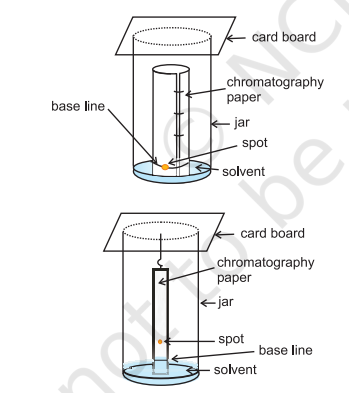
Fig.8.13 Paper chromatography. Chromatography paper in two different shapes.